



A COMPANY IN TRANSITION
CleanSpark, Inc. is evolving from a Bitcoin miner into a broader digital-infrastructure company, combining Bitcoin mining with the development of infrastructure for AI and high-performance computing.
The company reports more than 1.8 GW of power, land and data-centre infrastructure across the US. This power and infrastructure portfolio could become increasingly valuable as demand for AI/HPC capacity grows.
The key development is the Sandersville project, where CleanSpark has signed a 20-year triple-net lease expected to generate approximately $6.6 billion in contracted revenue. If successfully executed, Sandersville could mark an important shift in CleanSpark’s revenue mix—from the volatility of Bitcoin mining toward long-duration, contracted digital-infra revenues.
FINANCIAL PICTURE
CleanSpark has achieved significant scale, but its financial performance remains volatile.
FY2025 revenue rose 102.2% to $766.3 million, with net income of $364.5 million.
FY2026 has been more challenging.
Q3 revenue fell 30.5% YoY to $138 million, while the company reported a $239.8 million net loss. Revenue for the first nine months was approximately $455.6 million.
The Balance Sheet also warrants attention. As of June 2026, CleanSpark held $202.6 million in cash and $814.9 million in Bitcoin, against $1.8 billion of long-term debt and total assets of $2.7 billion.
The financial thesis therefore goes beyond revenue growth: CleanSpark must convert its power and infra-assets into durable contracted cash flows while managing the higher leverage required funding that expansion.
GROWTH DRIVERS
CleanSpark is expanding beyond Bitcoin mining into AI and high-performance computing infrastructure.
It has 1.8 GW of contracted power capacity, with 808 MW utilized as of August 2026. Its key advantage increasingly lies in the combination of power, land, grid access and infrastructure.
Bitcoin remains a significant operating driver. A stronger Bitcoin environment could support higher mining revenue, earnings and cash flow.
The $6.6 billion of contracted revenue associated with Sandersville could become a major long-term catalyst.
KEY RISK FACTORS
Bitcoin mining remains cyclical. Lower Bitcoin prices, rising network difficulty or higher energy costs can quickly pressure mining margins.
Leverage is a key risk. CleanSpark had approximately $1.8 billion of long-term debt and subsequently priced another $2.276 billions of secured notes for the Sandersville project. While the financing supports contracted infrastructure, it also increases financial obligations and execution pressure.
CleanSpark’s transition from Bitcoin mining to digital infrastructure is still underway. The thesis depends on successfully completing projects and converting planned capacity into the expected revenues and cash flows.
AI/HPC infrastructure requires substantial capital. Cost overruns, construction delays, power constraints or financing conditions could affect project economics and returns.
READING THE CHART
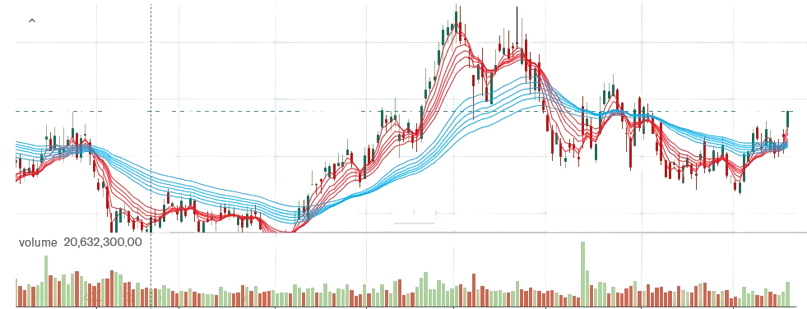
The chart uses the Guppy Multiple Moving Average and shows a notable change in the stock’s technical structure.
The key development is the recent reversal from the lower base. The stock has moved above the compressed moving-average structure and trading above the entire Guppy ribbon.
The chart also shows the short-term red averages turning upward, while the longer-term blue averages are beginning to flatten and turn higher. This represents a clear improvement from the earlier bearish structure.
The most encouraging feature is not simply the recent price rise, but the change in the moving-average structure. The short-term averages have moved above the longer-term cluster, while the longer-term averages are beginning to turn upward. This suggests the stock may be entering a new trending phase rather than merely experiencing a short-lived rebound.
From a technical perspective, improving GMMA structure is encouraging, but confirmation through sustained price action remains important.
IMPORTANT TECHNICAL LEVELS
Based on the chart and the current price structure, three levels stand out.
Immediate Support: $13.0–$13.5: This is the first support zone to watch during a normal pullback.
Resistance: $16–$17: A decisive move above this area, supported by expanding volume, would provide further technical confirmation of the developing uptrend.
TECHNICAL TARGETS
Short Term: $16.5–$17.5: The immediate technical zone is $16.5–$17.5. A period of consolidation or a controlled pullback toward support would be healthier than a sharp vertical rise. A decisive breakout above $17.5 could signal the next leg higher.
Medium Term: $19–$21: If CLSK holds above $17.5 and the Guppy averages continue expanding upward, the next technical zone is $19–$21, near the upper end of its recent trading range.
Long Term: $23–$25: A sustained breakout could eventually bring $23–$25 into focus. This remains a chart-based target, not a fundamental valuation estimate, and the zone could offer significant resistance given the stock’s previous highs.
INVESTMENT THESIS
CleanSpark combines Bitcoin exposure, large-scale power infrastructure and an emerging AI/HPC data-centre opportunity.
The longer-term thesis increasingly extends beyond Bitcoin mining: the potential to convert its power and data-centre assets into durable, contracted infrastructure revenue could materially change the business profile. The Sandersville agreement is an important step in that direction.
At the same time, the transition involves substantial execution, capital-allocation and financial risks. The key question is whether CleanSpark can convert its infrastructure portfolio into sustainable AI/HPC cash flows quickly enough to justify the capital being deployed.
You can share your views.
DISCLAIMER: These are the technical and fundamental views only and not a buy/sell recommendation.
The price targets and support/resistance levels presented in this report are chart-based reference levels derived from the chart and technical analysis and should not be interpreted as forecasts or guarantees of future performance.
CleanSpark remains exposed to significant risks, including Bitcoin-price volatility, mining economics, leverage, financing requirements, construction and execution risks, tenant-related risks and regulatory developments. Investors should therefore conduct their own research and consider their individual risk tolerance before making any investment decision.