



A $1.3 billion acquisition, rising dilution and an ambitious AI opportunity—is DustPhotonics the next growth engine or an expensive bet on the future?
Credo is a fast-growing AI connectivity supplier with a strong position in high-speed copper and expanding optical products. But customer concentration, acquisition execution, cash conversion and a premium valuation make this a stock to watch—not one to chase.
The investment question
At $123.95 on 17 November 2026, CRDO was about 60% below its 52-week high of $308.67 yet still carried a market value of roughly $24 billion. The correction has made the shares cheaper than before, but not conventionally cheap. The key question is whether Credo can turn rapid AI-related growth into durable, diversified per-share earnings.
Business and growth opportunity
Credo designs high-speed connectivity chips and systems used to move data between GPUs, servers, switches and storage. Its portfolio includes active electrical cables (AECs), optical transceivers and DSPs, retimers, SerDes chiplets and diagnostic software. It is fabless, relying on external manufacturing partners.
AI data centres need faster, more reliable and energy-efficient connections. Credo’s copper products serve shorter links, while optics address longer distances and rising bandwidth needs. Growth opportunities include 800G/1.6T optics, PCIe/CXL and next-generation scale-up networks. Its 1.6T Active Light Cable launch and work with Oracle on OCP telemetry are encouraging, but announcements are not yet proof of material revenue.
Competition and industry outlook
Credo competes with Broadcom, Marvell, Astera Labs and specialist optical suppliers. Its focused copper-and-optical portfolio and SerDes/DSP expertise are differentiators, but customers can dual-source, develop in-house products or shift architectures. The opportunity is structural; demand remains tied to hyperscaler spending, GPU rollouts and the pace of AI infrastructure investment.
The growth test is straightforward: convert design wins into repeat orders while protecting pricing, margins and customer relationships.
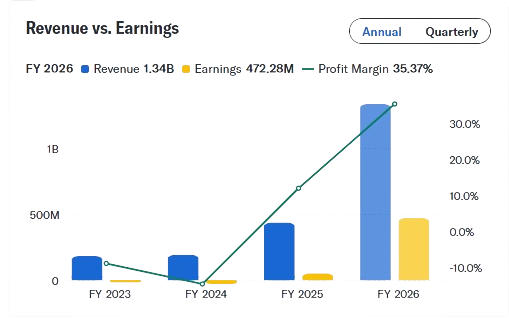
Financial performance: exceptional growth, moderating margins
Credo delivered a strong FY2026, with revenue more than tripling to $1.335 billion and net profit reaching $472.3 million.
Gross and operating margins stood at 68% and 33.3%, respectively.
Q1 FY2027 revenue grew 114.7% to $479 million, with GAAP gross margin of 64.5% and operating margin of 25.2%. Management guided for Q2 revenue of $525–535 million. Results were scheduled for 1 December 2026.
Key concern: Investors should watch whether growth translates into sustainable profitability, particularly after accounting for stock-based compensation.
Cash flow: strong generation, weaker conversion
Credo generated $407 million in free cash flow in FY2026. However, substantial stock-based compensation and rising inventory, receivables and supplier deposits warrant attention.
In Q1 FY2027, operating cash flow was $90 million, below net profit of $129 million. Inventory stood at $313 million, receivables at $289 million, while cash reserves fell to $764 million following the DustPhotonics acquisition. The company has no major conventional debt burden disclosed.
Key concern: Credo must improve cash conversion; control working capital and turn strong reported earnings into sustainable cash generation.
Acquisition and capital allocation: growth with execution risk
Credo acquired DustPhotonics for approximately $1.3 billion, adding silicon-photonics technology to strengthen its optical business. The opportunity is attractive, but successful integration and adequate returns must justify the price.
FY2026 also saw a $736 million net equity raise and $183 million in stock-based compensation, making dilution an important consideration.
Key concern: The real test is whether DustPhotonics delivers profitable growth and attractive returns on invested capital (ROCE), while limiting further shareholder dilution.
Valuation
At $123.95, Credo was valued at about $24 billion, or roughly 15.5 times trailing revenue and 46 times trailing GAAP earnings. Its market value was also around 56 times trailing free cash flow.
These are still demanding multiples for a business exposed to customer concentration, cyclical AI spending, SBC and acquisition risk. A lower share price does not automatically mean a bargain: the valuation assumes strong growth and healthy margins continue.
Peer perspective
Astera Labs reported Q3 FY2026 revenue growth of 154% and a 72.3% GAAP gross margin, compared with Credo’s latest quarterly growth of 114.7% and 64.5% gross margin. Product mixes and periods differ, but the comparison highlights the competition for investor capital. Broadcom and Marvell are larger and more diversified, so simple valuation comparisons are less useful.
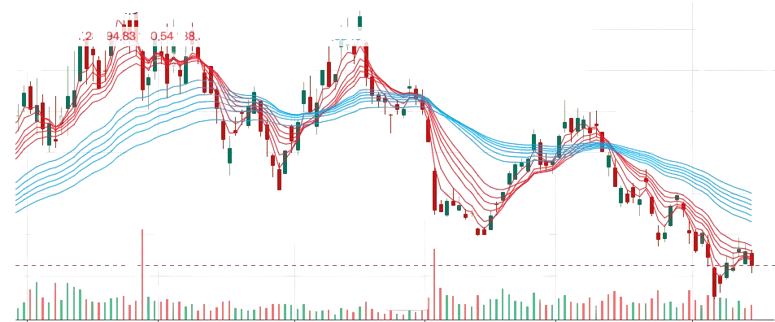
Technical outlook: rebound, not reversal
CRDO closed at $123.95 on 17 November 2026, after falling to $110.83 on 5 November, it rebounded to $141.41 before retreating.
The stock remains below all major moving averages, with RSI at 40.5 and MACD still negative. Trading volume has also failed to confirm strong buying interest. The stock remains with characteristics of a Weinstein Stage 4 decline. The recent bounce is not yet a confirmed reversal.
Key price levels and outlook
Short term: The stock may consolidate between $110 and $150. A sustained move above $150 with strong volume would improve sentiment, while a break below $110 would weaken the outlook.
Medium term: A move above $172–181 would indicate meaningful trend improvement.
Long term: Growth will depend on new customer wins, optical expansion and successful integration of DustPhotonics. A reliable long-term price target is not yet justified.
Key risks
Customer concentration: three end customers represented approximately 84% of FY2026 revenue.
Technology shifts: optics and changing interconnect architectures could alter demand for copper products.
Competition: larger suppliers may pressure pricing or displace design wins.
Acquisition risk: DustPhotonics must deliver revenue synergies and adequate returns.
Earnings quality: SBC, amortisation and dilution can reduce per-share value creation.
Cash and supply chain: rising inventory, receivables and supplier commitments can tie up cash.
AI spending and valuation: slower hyperscaler investment or weaker guidance could trigger further multiple compression.
What would change the thesis?
The outlook would improve if Credo sustains guidance, stabilises GAAP margins, converts earnings into cash, reduces customer concentration and demonstrates tangible DustPhotonics benefits. A stronger share-price structure above $150 and then $172–181 would add technical confirmation.
The thesis would weaken if major customers cut orders, margins fall, working capital keeps consuming cash, acquisition returns disappoint or dilution remains high. A sustained break below $110 would further damage the chart.

Investment outlook and verdict
Credo operates in an attractive AI infrastructure niche and has delivered exceptional growth. Its expanding optical portfolio and DustPhotonics acquisition offer further potential. But concentrated customers, weaker recent cash conversion, substantial SBC and a still-premium valuation leave little room for execution missteps.
The Listed Edge recommends starting gradual accumulation at current levels while waiting for earnings improvement and trend confirmation before committing additional capital.
The 1 December 2026 results are the next key checkpoint. Focus on revenue, GAAP margins, cash conversion, inventory, customer commentary and early acquisition contribution before treating the correction as an opportunity.
Disclaimer
This report is for information and education only. It is not investment advice or a recommendation to buy or sell any security. The writer has no association with Credo Technology Group Holding Ltd or its management and has not contacted the company for this research. Information is based on publicly available sources and may change. Readers should verify the data and conduct their own due diligence. Equity investments involve market risk, including possible loss of capital.