


At around US$12.75, NTLA is becoming technically interesting just as its fundamental story approaches a major regulatory event.
Positive Phase 3 data for lonvo-z and FDA acceptance of its BLA have moved the NTLA from a pure technology story toward a potential commercialisation one.
In Brief
Intellia Therapeutics is developing in-vivo CRISPR gene-editing therapies designed to address diseases at their genetic source.
Its two key programmes are:
Lonvo-z — Hereditary Angioedema
Nex-z — Transthyretin amyloidosis, being developed with Regeneron
The attraction is straightforward: instead of lifelong treatment, a successful therapy could potentially provide durable or even one-time disease control.
Lonvo-z Changes the Investment Case
The biggest development came in April 2026, when Phase 3 HAELO data showed an 87% reduction in HAE attacks versus placebo during the six-month evaluation period.
More importantly, 62% of patients were both attack-free and free from ongoing prophylactic therapy, versus 11% for placebo. The reported safety profile was also favorable in the trial.
The next major milestone has already arrived. The FDA accepted Intellia’s BLA for lonvo-z under Priority Review, with a PDUFA action date of March 10, 2027. That makes the FDA decision the single most important near-term catalyst for NTLA.
Financial Position — the Cushion Matters
Intellia remains a loss-making development-stage biotech.
Q2 FY2026 included:
Collaboration revenue: $7.70 million
R&D expense: $82.60 million
G&A expense: $37.80 million
However, the balance sheet provides some comfort. As of June 2026, the company had approximately $628.40 million in cash, cash equivalents and marketable securities, with management expecting resources to fund operations into 2028, excluding potential commercial revenue from lonvo-z. This reduces, although does not eliminate, near-term financing pressure.
What Could Drive the Next Phase?
The investment case now has four major potential drivers:
FDA approval of lonvo-z: The March 10, 2027, decision could potentially transform Intellia from a clinical-stage biotech into a commercial company.
Commercial launch: If approved, NTLA expects a US launch in 2027. A successful one-time HAE treatment could address a significant unmet need.
Nex-z / ATTR: Positive progress here would provide Intellia with a second major commercial opportunity and further validate its CRISPR platform.
Platform validation: Perhaps the biggest long-term opportunity is proving that Intellia’s in-vivo CRISPR technology can become a repeatable drug-development platform rather than a one-product story.
What the Chart Says
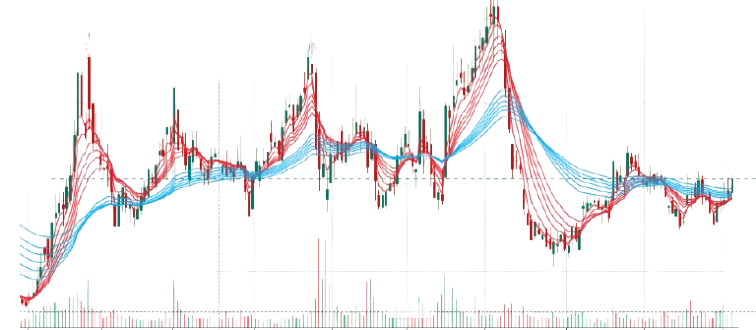
The GMMA chart has improved materially from the previous breakdown, but it does not yet show a fully established Stage-2 uptrend.
After the sharp decline, NTLA formed a base and has subsequently moved into a sideways consolidation/recovery phase. The red short-term and blue longer-term moving-average groups have compressed considerably. This is important because such compression can precede a stronger directional move.
At the latest price of, however, the stock is still interacting with the GMMA cluster rather than clearly breaking above it.
Technical Interpretation
Trend: Stabilising after a prolonged decline
GMMA: Considerably compressed — an early sign of potential trend change
Momentum: Improving, but not yet decisively bullish
Volume: Recent activity is supportive, a major breakout should come with stronger volume
The key technical signal would be a sustained move above the GMMA cluster with expanding volume. That would provide stronger evidence that the stock is transitioning from accumulation into a genuine uptrend.
Chart is no longer merely recovering — it is beginning to set up for a possible trend reversal awaiting confirmation.
Risks Remain High
This remains a biotechnology investment and should not be confused with a conventional earnings-based compounder.
The principal risks are:
Regulatory risk: Positive Phase 3 data does not guarantee FDA approval.
Long-term safety: Permanent genetic modification carries questions around durability and off-target effects.
Commercialisation: FDA approval would be followed by the challenge of reimbursement, physician adoption and building a revenue generating commercial organisation.
ATTR risk: Nex-z has its own clinical and safety considerations and should not be treated as guaranteed future revenue.
Investment View
NTLA is becoming increasingly interesting for investors comfortable with high-risk biotechnology.
The combination of positive Phase 3 data, FDA Priority Review, regulatory catalyst, a substantial cash position and an improving GMMA structure creates a potentially attractive asymmetric setup.
The chart is particularly encouraging because the long decline has been followed by base formation and moving-average compression. A convincing breakout above the GMMA cluster could mark the beginning of a new technical phase.
This is still an event-driven stock. The investment thesis ultimately depends on the sequence of above events.
Our stance
For investors willing to accept substantial volatility, NTLA merits close monitoring and a positive bias. A sustained technical breakout would improve the risk-reward equation further, while failure to hold the current base would suggest patience.
Fundamentals provide the catalyst; the GMMA structure is beginning to provide confirmation; position sizing remains the key risk-control tool.
Disclaimer
This report is for informational and educational purposes only and should not be considered investment advice or a recommendation to buy or sell securities. Biotechnology investments can be exceptionally volatile and involve significant clinical, regulatory, financial and commercial risks.
The writer does not have any financial or other interest in NTLA, is not associated with the company in any form and has no relationship with the company or its management. The information and analysis presented above are based on publicly available information and may change as new developments occur.
Investors should conduct their own due diligence and consult a qualified financial adviser before making investment decisions.