


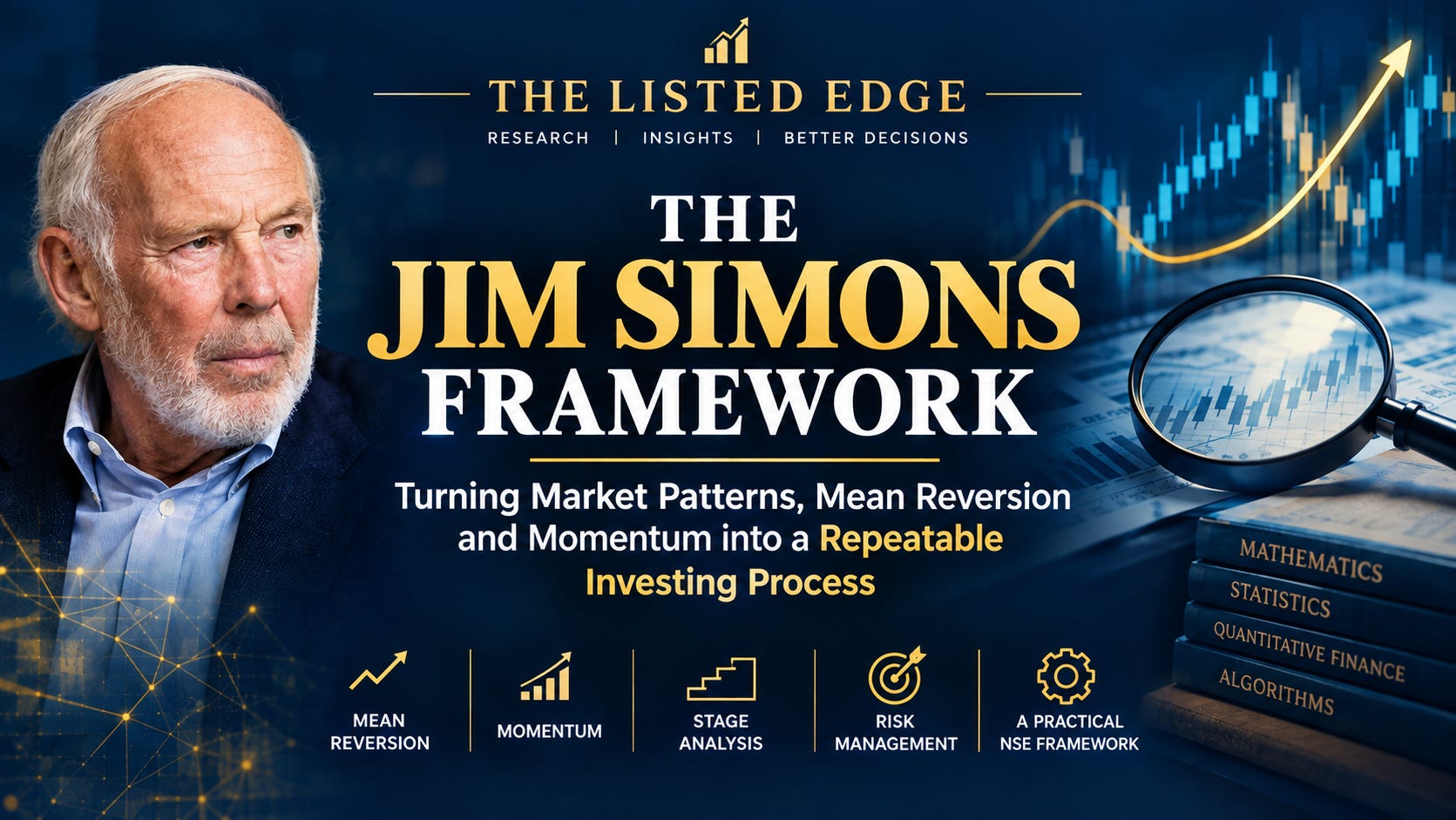
Imagine being right on only slightly more than half your trades—and still building an extraordinary investment record.
That was the idea behind Jim Simons and Renaissance Technologies. A mathematician and codebreaker, Simons used mathematics and data to search for small, repeatable market patterns rather than relying mainly on forecasts or intuition.
The key lesson is simple: a small, genuine edge, applied consistently with discipline, can become remarkably powerful.
From Mathematics to Markets
Jim Simons was a distinguished mathematician long before entering finance. He earned his PhD from UC Berkeley, worked as a codebreaker and later chaired mathematics at Stony Brook University. His work with Shiing-Shen Chern influenced modern mathematics and physics.
Around 40, Simons turned to financial markets, asking whether mathematics and data could uncover repeatable market patterns.
This led to Renaissance Technologies, where he brought together mathematicians, physicists, statisticians and computer scientists—many without traditional trading backgrounds.
The core idea was simple: replace intuition-driven investing with data, patterns and systematic strategies.
The Medallion Fund: An Extraordinary Record
Launched in 1988, the Medallion Fund became Jim Simons’ most famous investment operation.
From 1988–2018, it reportedly delivered about 66.10% annual returns before fees and 39.10% after fees. During the 2008 crisis, it reportedly gained more than 80% after fees, while the S&P 500 fell about 38%.
However, Medallion is a private fund and does not publish audited results comparable with public investment companies. Its capacity was also deliberately limited, with profits distributed to investors.
The key takeaway is not to expect similar returns, but that Renaissance appears to have built a persistent quantitative edge and applied it with extraordinary discipline.
How Simons Compares with the Investment Greats
The reported 39.10% annual return after fees for Medallion is often compared with approximately 32% for George Soros’ Quantum Fund, 29% for Peter Lynch’s Magellan Fund, and 20.50% for Warren Buffett’s Berkshire Hathaway over their respective periods. The broader lesson is that extraordinary results can come from very different investment processes.
The Renaissance Approach
Renaissance Technologies did not rely on one magic formula. It analyzed vast amounts of market data and used multiple models and signals across stocks, futures, currencies, commodities and bonds.
Data quality was critical, while hundreds or thousands of models could operate simultaneously.
The philosophy was simple: combine many small, repeatable opportunities rather than depend on one big prediction.
Simons’ model-driven approach also reduced emotional interference—an idea investors can apply more broadly: rules created with a calm mind can protect against emotional decisions during stressful markets.
The Power of a Small Edge
Perhaps Simons’ most important lesson is the power of repetition.
An investor does not need to be right 70% or 80% of the time. A small, genuine edge, repeated consistently, can become meaningful over many trades.
The exact 50.75% example is less important than the principle. Real markets involve different trade sizes, costs, taxes, slippage and changing conditions—and past success may not continue.
The key lesson is simple:
A small advantage becomes valuable only when it is real, measurable and repeatable.
Evidence Over Intuition
Simons’ philosophy challenges investors to value evidence over stories.
A company may have strong management, a growing industry or a large market opportunity—but a compelling story does not necessarily prove an investment edge.
The better question is:
When similar conditions occurred in the past, what happened next?
Technical indicators, momentum, breakouts and other setups can be treated as hypotheses and tested for frequency of success, average outcomes, drawdowns and performance across different market conditions.
The key shift is from prediction to measurement—turning market opinions into evidence that can be analysed.
What Indian Investors Can Learn
Individual investors cannot replicate Renaissance Technologies, but they can adopt some of its principles.
Start with a clearly defined, repeatable setup using factors such as price structure, momentum, RSI, moving averages, GMMA or Stage Analysis. Turn the idea into rules rather than relying on “I like this stock.”
Then test the setup historically, examining the success rates, returns, drawdowns and performance across different market conditions.
Before committing capital, define the entry, invalidation level, position size and profit-taking rules.
The goal is not to replicate Renaissance, but to bring discipline, measurement and consistency into investing.
The Limits of the Simons Approach
Quantitative investing has an important limitation: historical data can create false confidence. A strategy may look excellent in back-tests simply because it has been over-optimized for the past—a problem known as overfitting.
Renaissance also had enormous datasets, advanced technology and specialized researchers, while retail investors face costs, taxes, slippage and execution constraints.
The goal, therefore, is not to recreate Medallion, but to adopt its discipline:
Measure, test, control risk and change when the evidence changes.
The Bigger Investment Lesson
Jim Simons’ greatest contribution may have been a different way of thinking about uncertainty.
Instead of asking “What will happen to this stock?”, the Simons approach asks:
“When these conditions occurred before, what happened next—and how consistently?”
Whether fundamental, technical or long-term, investors can apply the same principles:
Define the process. Measure results. Control risk. Avoid emotional decisions. Keep learning. Question your assumptions.
The Bottom Line
Jim Simons’ story is about more than mathematics—it is about finding an edge and testing whether it is real. The reported Medallion results are extraordinary, but their private, capacity-constrained structure and methodological limitations warrant caution.
Investors can adopt the Simons mindset by putting data over opinion, evidence over stories, probabilities over predictions, rules over emotions, many small edges over one big bet, and continuous testing and improvement.
You may never have Renaissance’s resources, but you can test ideas, measure results, control risk and question assumptions.
The enduring lesson is simple: replace “I think” with “What does the evidence show?”
Disclaimer
This report is for educational and informational purposes only and is not investment, financial or research advice, nor a recommendation to buy, sell or hold any security.