


Kristjan Kullamägi, better known as Qullamaggie, did not begin his trading career from a conventional financial background. Born in Sweden, he was studying biomedical laboratory science in his early twenties while working part-time as a security guard, including a stint at the Nasdaq Stockholm building. His exposure to the people and businesses connected with the markets gradually developed into an interest in trading.
In 2011, at around 23, he began trading U.S. stocks with approximately US$5,000 of savings. The early years were difficult. He followed online day traders, lacked a defined system and proper risk management, and blew up several small accounts. After each setback, he returned to his security job, saved money and continued studying charts and successful traders.
He eventually left his degree in its final months to concentrate fully on trading. By 2013, he had his first profitable year and gradually moved from day trading towards swing trading. His subsequent journey involved thousands of hours studying charts, market leaders and historical setups before he developed the focused framework for which he is now known.
Three Setups at the Core
Kullamägi’s methodology is centred around three broad setups:
1. Breakouts
2. Episodic Pivots (EPs)
3. Parabolic Shorts
The philosophy is relatively simple:
Find exceptional stocks → wait for a specific structure → enter when momentum confirms → control risk → allow strong winners to run.
Breakouts: Strength Before the Break
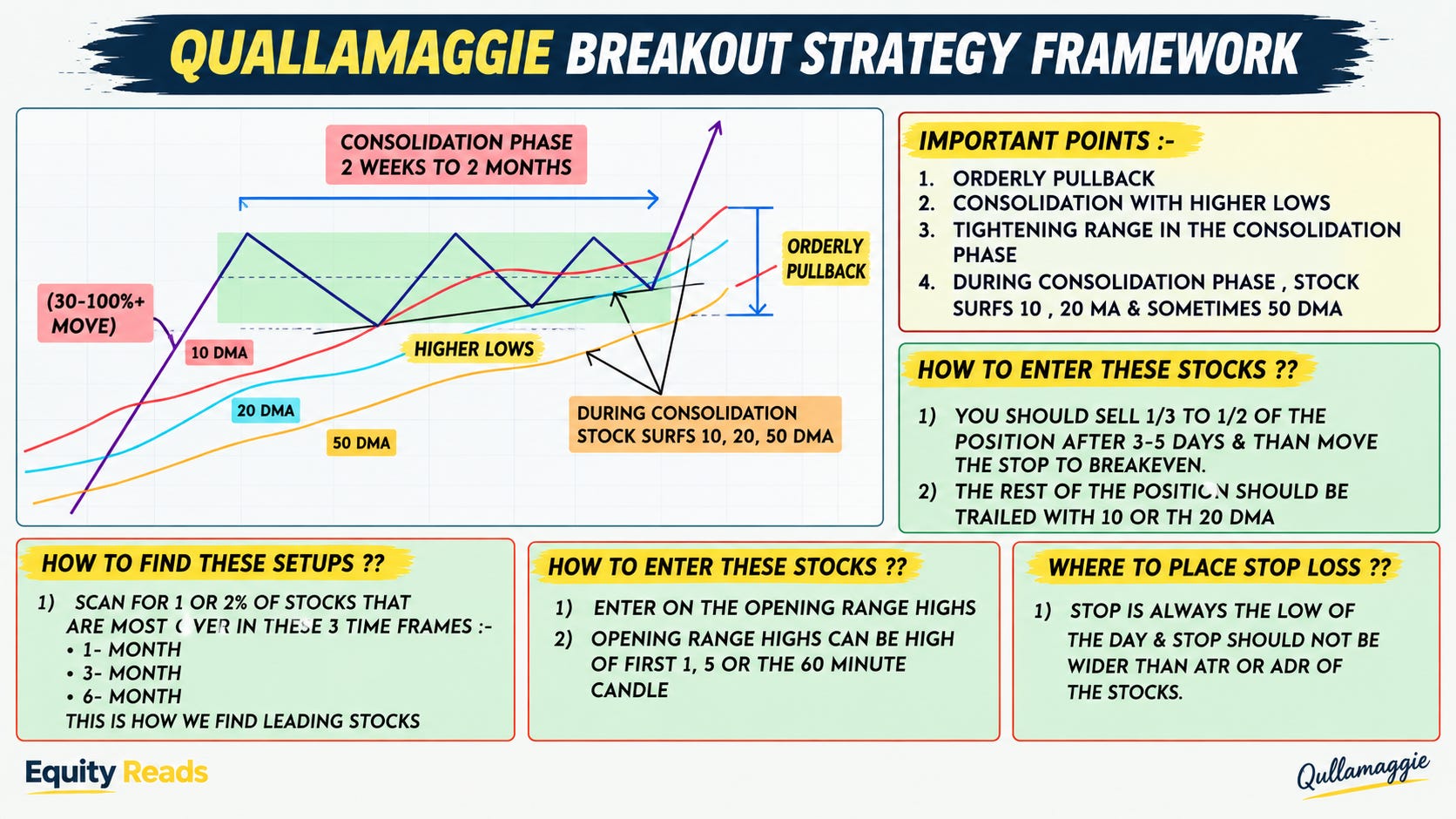
Kullamägi generally looks for stocks that have already demonstrated leadership through strong 1-month, 3-month and 6-month performance.
A typical pattern is:
Strong advance → consolidation → renewed expansion
The consolidation matters. He looks for higher lows, tightening price action, declining volatility and support around the 10-day and 20-day moving averages, followed by decisive price and volume expansion.
The idea is not simply to buy because resistance has been crossed. The bigger question is:
Has a strong stock consolidated constructively before attempting another expansion?
Episodic Pivot: When Expectations Change
An Episodic Pivot occurs when new information suddenly changes the market’s perception of a company.
Examples include exceptional earnings, major guidance changes, FDA developments, large contracts or unexpected corporate developments. These events can produce a significant price gap accompanied by exceptional volume.
Kullamägi has particularly studied EPs in stocks that had previously spent 3–6 months or more moving sideways. More importantly, he studied thousands of historical examples before becoming confident in the setup.
Parabolic Shorts: Waiting for the Turn
The third setup is effectively the opposite of a breakout:
Extreme acceleration → excessive extension → failure/reversal
But being overbought is not enough.
The reversal has to begin.
Kullamägi has acknowledged that some of his largest losses came from short positions, including losses involving TVIX and KODK.
The lesson is important: extreme strength does not automatically mean an immediate reversal.
Risk Management Comes First
Perhaps the most transferable part of his approach is risk management.
Kullamägi has described typical positions of around 10–20% of account value, while generally risking only around 0.25–1% of total account equity per trade.
The distinction is crucial:
Position size ≠ risk.
For example, on a ₹10 lakh account, a ₹2 lakh position with a 4% stop represents a planned loss of ₹8,000—or only 0.8% of the account.
The objective is not to avoid losses. It is to ensure that one loss does not damage the ability to participate in the next opportunity.
Moving Averages as Trend Tools
The 10-day and 20-day moving averages are important in Kullamägi’s framework, but not primarily as crossover signals.
They are used to understand trend behaviour and manage positions.
A strong stock may:
Run → pull back → find support near the 10/20 DMA → resume higher.
The averages therefore provide trend context and trade-management references, rather than acting as a standalone strategy.
Study Thousands of Charts
One of the strongest lessons from Kullamägi’s methodology is the importance of historical study. He advocates examining thousands of examples, including successful and failed breakouts, EPs, parabolic reversals, volume behaviour, consolidation, entries, stops and follow-through.
This is how a trader develops pattern recognition rather than simply memorising setups.
A Losing Trade Can Still Be a Good Trade
Kullamägi makes an important distinction between trade outcome and trade quality. A losing trade can still be a good trade if the setup was valid, risk was controlled and the process was followed.
Likewise, a profitable trade can be a poor trade if it violated the trading plan.
For technical traders, the lesson is simple:
Judge the process first; the outcome comes later.
The EquityReads Takeaway
Kullamägi’s story is ultimately less about the headline “$3,000 to $100 million” and more about the process that came before it.
Repeated failures led to deeper study. Study led to specialization. Specialization led to a focused playbook.
His framework reminds technical traders that a breakout is not simply a price crossing resistance.
It is about leadership, momentum, structure, volume, market conditions and risk.
And perhaps the biggest lesson is simple:
The objective is not to predict every market move. It is to develop a repeatable process that allows you to participate when the right opportunity appears.
The next logical step is to adapt this framework to Indian equities through relative-strength screening, momentum filters, 10/20/50 DMA structure, breakout volume, catalyst-driven setups, reversal patterns, position sizing and market-regime filters.
Disclaimer
Technical view only; not a buy/sell recommendation
This article is intended for educational and informational purposes only. The performance figures associated with Kristjan Kullamägi are self-reported and are not presented as independently audited investment returns. Past trading performance does not guarantee future results. Readers should conduct their own research and consider their individual risk tolerance before making any investment or trading decision.