



Is MDA building a durable space technology business?
The next generation of critical infrastructure may increasingly depend on space. Satellite broadband, defence communications, Earth observation, geospatial intelligence and autonomous space operations are expanding beyond traditional government-funded exploration.
MDA Space is positioned across these markets through three businesses: Satellite Systems, Robotics & Space Operations and Geointelligence.
The central investment issue is not about the space industry, but whether MDA can convert that opportunity into sustainable free cash flow, attractive returns on capital and higher diluted earnings per share.
Business model, competitive position and industry outlook
MDA’s business model combines technology development, manufacturing, mission integration and operational services.
Satellite Systems is the largest division, contributing approximately 69% of nine-month revenue. It develops satellite platforms, communication payloads, digital antennas and related systems. Telesat Lightspeed is a particularly important growth programme. During 2026, MDA also secured an additional C$474 million in contract value through the expansion of Lightspeed by 27 satellites and associated programme requirements.
Robotics & Space Operations builds on MDA’s established Canadarm heritage. Its capabilities include robotic systems, mechanisms and mission-support services. Canadarm3 and the wider lunar exploration ecosystem offer opportunities, although programme timing remains dependent on government funding and mission schedules.
Geointelligence provides Earth-observation imagery, satellite data, maritime monitoring and analytical services. The business has strategic relevance for defence, environmental monitoring and national security.
MDA’s competitive advantage rests on more than manufacturing capacity. Its 55-year operating history, flight-proven technology, intellectual property, established customer relationships and experience across more than 450 space missions create meaningful barriers to entry.
Growth opportunities
Three developments deserve particular attention.
European IRIS²: On 30 October 2026, MDA announced an authorisation-to-proceed agreement worth more than C$100 million to supply digital antenna subsystems for 66 early-delivery satellites.
Blue Canyon Technologies: The proposed US$620 million acquisition would expand spacecraft manufacturing, components and access to the US defence market. Management expects adjusted EBITDA and adjusted EPS accretion in 2027.
CLS: The proposed acquisition of approximately 70% of Collecte Localisation Satellites for €567 million (approximately C$920 million) would add Earth-observation data services, maritime monitoring and AI-driven geospatial analytics.
Both acquisitions remained subject to outstanding closing conditions and approvals at the latest reporting date. Management indicated on the November 5 earnings call that Blue Canyon was expected to close later in 2026 and CLS in late 2026 or early 2027.
The strategic rationale is credible: MDA could move further towards an integrated space infrastructure and intelligence provider. But acquisition-led growth is not automatically value creation. Integration, customer retention, financing costs and returns on the purchase consideration will determine the outcome.
Growth is strong, but earnings quality needs attention
The nine months ended 30 September 2026 produced the following results:
Revenue: C$1,460.8 million, up 28.8%.
Gross profit: C$367 million, up 30%.
Gross margin: 25.1%, against 24.9%.
Q3 revenue grew 21.5% to C$498.1 million, while adjusted EBITDA increased 15.9% to C$96 million. The quarterly adjusted EBITDA margin declined from 20.2% to 19.3%.
This difference matters. Revenue growth is currently outpacing the growth of adjusted EBITDA, suggesting that programme mix, investment expenditure and operating costs are constraining incremental profitability.
The gap between adjusted and statutory earnings also deserves scrutiny. Nine-month amortisation of acquired intangible assets reached C$92 million, compared with C$53.3 million in the previous corresponding period. Share-based compensation and acquisition-related expenses also affect the reconciliation.
Such adjustments do not necessarily indicate poor underlying operations. However, acquisition-related amortisation is an economic consequence of capital deployed and should not simply be disregarded when evaluating shareholder returns.
Cash flow: The most important financial concern
Q3 operating cash flow improved to C$106.2 million from C$32.8 million, while free cash flow was positive C$61.6 million compared with negative C$36.7 million a year earlier.
Balance sheet, debt and capital allocation
At 30 September 2026, MDA reported:
Cash: C$2,153.8 million.
Long-term debt: C$825.8 million.
Net cash: C$1,328 million.
Total available liquidity: C$2,853.2 million.
The balance sheet therefore appeared strong before the proposed acquisitions.
Dilution and return on capital
MDA’s common shares outstanding increased from approximately 126.3 million at the beginning of 2026 to 162.2 million at September-end. A 23-million-share bought deal in July alone generated gross proceeds of US$818.8 million.
The funding strengthened the balance sheet, but shareholders have paid a price through dilution. Q3 adjusted net income increased 26.1%, yet adjusted diluted EPS remained approximately C$0.37, virtually unchanged year-on-year.
The longer-term test is whether Blue Canyon, CLS and manufacturing expansion generate returns comfortably above their financing and acquisition costs.
A good company is not necessarily a good investment at every price
MDA closed at C$43.41 on 9 November 2026, representing a market capitalisation of approximately C$7.04 billion and enterprise value of approximately C$5.85 billion.
The valuation is not inexpensive relative to current statutory earnings. Investors are paying for future growth, improved earnings capacity and the potential benefits of the acquisitions.
Valuation verdict: The business has considerable potential, but the current share price already incorporates meaningful expectations. Further appreciation requires earnings growth per share, better cash conversion and successful acquisition integration.
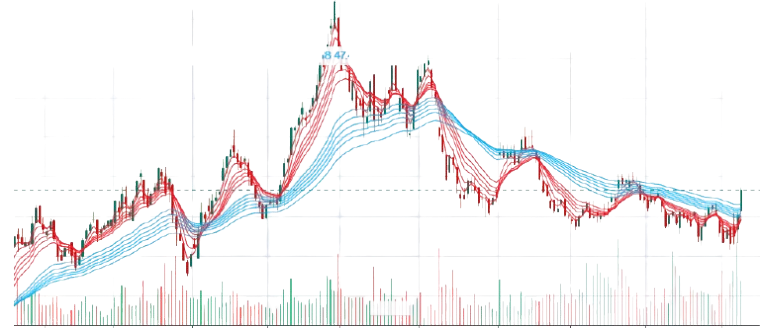
Recovery is improving, longer-term reversal needs confirmation
MDA has recovered sharply from its recent correction. The C$43.41 close represented an 8.09% daily gain. The stock nevertheless remained approximately 36% below its 52-week high of C$67.90.
Daily trend and moving averages
The price has recovered above its 20- and 50-day averages. RSI indicates improving momentum without the extreme overbought reading associated with an unsustainable short-term surge.
However, the 100-day and 200-day averages remain overhead. The 50-day average is also below the longer-term averages.
This is evidence of improving short-term momentum, not conclusive proof of a long-term reversal.
Weekly trend and Stan Weinstein stage
The broader three-month performance remained negative despite the recent recovery. The share price has yet to establish a sustained position above its 200-day average.
My Weinstein-style interpretation is a transition from a corrective phase towards a potential Stage 1 base, with an eventual Stage 2 advance possible if the price breaks and holds above the longer-term trend.
A definitive Weinstein classification requires examining the slope of the 30-week moving average. That specific verified reading is unavailable, so a confirmed Stage 2 designation would be premature.
Important price levels
The following are approximate technical observation zones, not guaranteed turning points:
C$44.50–45.30: Immediate resistance, around the 100/200-day averages.
C$49–50: Next significant upside resistance zone.
C$40.50–41: First important support.
A sustained close above C$45.30 with supportive volume, followed by a successful retest, would strengthen the bullish interpretation. A decisive failure below C$38 would substantially weaken the recovery structure.
Price scenarios
Short term: A sustained breakout above C$45.30 could open a move towards C$49–50. Failure at resistance could result in consolidation or a retest of C$40.50–41.
Medium term: C$52–62 represents an optimistic execution-dependent scenario, requiring continued revenue growth, successful acquisition completion, margin stability and improving free cash flow.
Long term: C$65–75 is a more ambitious growth scenario, conditional on successful integration, stronger diluted EPS, backlog replenishment and improving returns on capital. It should be treated as a possibility rather than an established target.
Principal risks and the bear case
The principal risks are interconnected.
Programme concentration: Satellite Systems accounts for the majority of revenue. Delays, cost overruns or changes in customer requirements on large programmes could affect margins and cash flow.
Backlog replenishment: Backlog declined from C$4.39 billion in Sep 2025 to C$3.95 billion in Sep 2026. Nine-month bookings of C$1.40 billion were below recognised revenue of C$1.46 billion. This is not proof of weakening demand, but sustained expansion requires bookings to consistently replenish revenue.
Acquisition and integration risk: Blue Canyon and CLS could strengthen MDA’s capabilities, but the transactions introduce financing, regulatory, employee-retention and integration risks.
Financial risk: The acquisitions will increase leverage, while the 6.5% notes create an additional financing cost. Persistent working-capital requirements could also constrain investment capacity.
Competitive and regulatory exposure: MDA faces established aerospace contractors and specialised technology businesses. Export controls, security clearances, government procurement policies and changes in defence budgets could affect market access and programme economics.
The bear case is therefore not necessarily that the space industry stops expanding. It is that MDA fails to earn sufficient incremental returns on the capital being deployed to justify the valuation investors are paying today.
What Would Change My Mind?
I would become materially more constructive with following developments:
Backlog stabilises and new order bookings consistently exceed recognised revenue.
Operating cash flow improves and free cash flow becomes sustainably positive.
Reported earnings begin growing alongside adjusted earnings, with diluted EPS accelerating.
Blue Canyon and CLS demonstrate measurable earnings accretion without excessive leverage.
ROCE improves as the enlarged asset base is deployed.
The share price establishes a sustained Stage 2 uptrend, with the 200-day and 30-week moving averages supporting the advance.
Conversely, repeated guidance reductions, declining backlog, persistent negative free cash flow, margin deterioration or further material dilution would make me reconsider the investment thesis.
A promising growth business, but price discipline matters
MDA Space has a credible position in an industry with significant long-term strategic and commercial potential. Its technology portfolio, established customer relationships, contracted programmes and exposure to defence and satellite infrastructure provide a meaningful foundation for growth.
The latest financial results confirm that the business is expanding. The IRIS² agreement and proposed acquisitions could further strengthen its international position, particularly in spacecraft manufacturing and geointelligence.
The balance sheet provides financial flexibility, but the proposed acquisitions will change its risk profile. Their success must ultimately be demonstrated through incremental earnings per share, free cash flow and improved returns on invested capital.
My assessment is:
Business fundamentals: Positive.
Industry and growth outlook: Positive.
Financial performance: Improving, with profitability and cash-flow qualifications.
Balance sheet: Strong at Sep-end, but subject to acquisition-related changes.
Capital efficiency: Requires improvement and further evidence.
Valuation: Demanding.
Technical trend: Short-term recovery; longer-term reversal unconfirmed.
Overall investment bias: Constructive, but valuation conscious.
For a longer investment horizon, MDA deserves serious consideration. However, a convincing breakout above C$45.30, supported by volume, or a constructive pullback towards established support has greater Risk Reward
Medium-term scenario is achievable if the company executes successfully and longer-term scenario requires considerably stronger evidence of cash generation, earnings growth and acquisition returns.
The Listed Edge perspective: MDA Space is more than a speculative bet on the future of satellites. It is an established technology business participating in the expansion of strategically important infrastructure. Its long-term opportunity is credible, but the next phase must demonstrate that growth can produce sustainable cash and better returns for existing shareholders.
We would retain a positive long-term view while remaining selective about the entry price. The distinction between a promising industry and a rewarding investment will ultimately be determined by the quality of earnings, returns on capital and the valuation paid.
Disclaimer
This report has been prepared solely for informational and educational purposes. It does not constitute investment advice, a recommendation to buy or sell any security, or a solicitation to undertake any investment transaction.
The analysis is based on publicly available company filings, financial statements, investor presentations, exchange disclosures and other sources considered credible at the time of preparation. Financial figures, market prices, technical indicators, valuation multiples and forward-looking estimates are subject to change. Management guidance, acquisition expectations and scenario-based price assessments are not guaranteed outcomes.
The writer has no association, affiliation, business connection or other relationship with MDA Space Ltd, its management, promoters, employees or subsidiaries, and has not contacted the company or its management in connection with this report. This report represents an independent assessment based entirely on publicly available information.
Readers should conduct their own due diligence and consult an appropriately qualified investment professional before making investment decisions. Equity investments involve market risk, including the possible loss of capital.
The Listed Edge
Studying companies beyond the headlines. Independent research. Evidence-led investing